Guilt Trip
EN · EnglishThe accompanying essay is a small, self-imposed punishment for never publishing LIGNES DE FUITE, volume four.
The Frontier as Retrospective Image: Closure and Historical Time in END
Milan Tanedjikov
Introduction
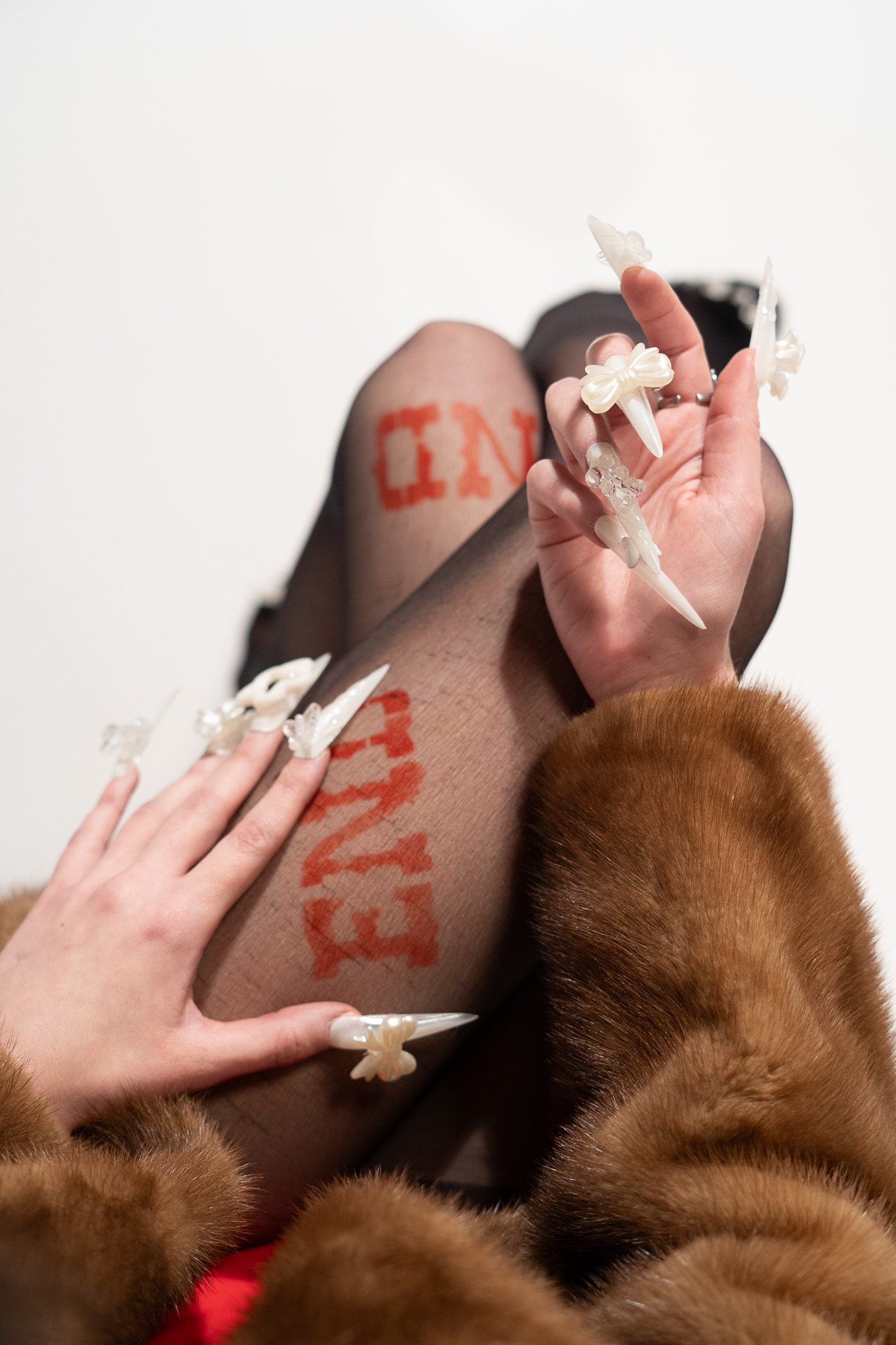
The photograph presents a tightly cropped body framed by brown fur or fur-like material, sheer tights bearing the word END, and elongated, ornamented nails. Its explicit announcement of closure is complicated by the Western associations of its typography. A visual language associated with territorial expansion and individual departure is used to announce an ending.
This essay examines that contradiction through Greg Grandin’s account of the American frontier, Mark Fisher’s analysis of cultural repetition and Zygmunt Bauman’s concept of retrotopia. It proposes that the image makes visible a tension within fashion’s relationship to novelty: the signs of departure can remain desirable after becoming familiar historical references.
Formal Organisation
The composition excludes the face and most environmental information. Attention concentrates on contrasting surfaces: the transparency of the tights, red lettering, dense brown pile and pale nail ornaments. The hands interrupt the larger areas of material, directing attention towards small, elaborately constructed details.
END appears more than once and follows the orientation of the legs. Reading requires a movement of attention across the body. The word consequently functions as both a statement and a decorative motif. Its repetition complicates its finality: an announcement of cessation becomes an element capable of continued reproduction.
The raised finger introduces a recognisable gesture of refusal, although its addressee remains outside the frame. Ornamentation increases the gesture’s visibility. The hand is presented for visual attention while simultaneously appearing to reject an unspecified demand.
The Frontier and Its Closure
The Western-style lettering evokes a cultural vocabulary associating territory, movement and individual autonomy. This association does not establish the wearer’s beliefs or a definitive political intention. Nevertheless, its conjunction with END makes the relationship between expansion and closure a productive subject of interpretation.
In The End of the Myth, Grandin (2019) examines the frontier as a governing narrative of American history. Territorial and economic expansion repeatedly offered an apparent means of escaping domestic conflict. His account identifies the border wall as a successor symbol: an emphasis on boundaries and exclusion displaces the promise of unrestricted outward movement.
Grandin’s argument also prevents the frontier from being understood as an innocent image of freedom. The territory was already inhabited. Its supposed availability depended on dispossession, and the opportunities it offered were distributed unequally. Acknowledging the exhaustion of this promise does not require endorsing its historical terms.
Within the photograph, the frontier persists as a recognisable aesthetic language. Its associations remain available even when the word they frame announces termination. The image brings the promise of departure and the possibility of its closure into the same visual field.
Fashion and the Recognition of Novelty
Fashion’s use of historical references does not, in itself, demonstrate a failure of invention. Revival and recombination can generate unfamiliar relationships between existing forms. A distinction is nevertheless necessary between revisiting an earlier experiment to develop its possibilities and invoking it to secure recognition.
Fisher (2014) examines the coexistence of intensive cultural activity and a diminished experience of historical transformation. His argument distinguishes the continued production of new releases from the emergence of a convincingly different future. Applied to fashion, it raises a question about the criteria through which novelty becomes intelligible.
An archival garment possesses more than material form. It may carry an established interpretation: a collection recognised as radical, a silhouette understood as a turning point, or a designer associated with a decisive departure. These judgments can accompany its reproduction. The appearance of innovation becomes available through reference to an innovation already accepted.
The photograph makes a related tension visible. END gains part of its force through lettering whose associations are familiar. Its statement of closure depends on a visual language that continues to circulate. Historical recognition enables the apparent announcement of a break.
Retrotopia and the Direction of Desire
Bauman’s Retrotopia (2017) describes the relocation of collective hopes towards an imagined past. A desirable condition is understood as something lost and potentially recoverable. The future becomes the site of a proposed restoration.
This concept offers a framework for examining fashion’s investment in provenance. An earlier design can promise the recovery of quality, authenticity or creative confidence. Its previous existence supplies reassurance that a wholly unfamiliar proposal cannot offer.
Fashion revival and political restoration are not equivalent. Their consequences and purposes differ. However, both can authorise a proposed future through an earlier condition. The relevant question is not whether the past is used, but what its use is expected to guarantee.
The image’s Western lettering permits a particularly complex version of this reading. The frontier was itself a promise of beginnings. Its retrospective use can therefore express nostalgia for a period imagined as less nostalgic: a time when departure appeared possible. What is recovered is the image of an orientation towards the future.
Material Ambiguity and Interpretive Limits
The nails and fur-like material complicate an exclusively historical interpretation. Their tactile and ornamental qualities retain an immediate visual appeal that cannot be reduced to their associations.
Veblen’s (1899) account of dress as evidence of exemption from productive labour offers one interpretation of the nails’ apparent impracticality. Yet the photograph cannot establish the wearer’s occupation or capacities. Their elaborate construction also implies skilled work. The appearance of leisure and the evidence of fabrication coexist.
Similarly, the photograph does not establish the coat’s composition, age or provenance. Describing it as vintage would introduce questions of preservation and inheritance; identifying it as newly produced animal fur would produce a different ethical discussion. Neither attribution can responsibly be made from the image alone.
These uncertainties are consequential. They prevent the analysis from treating the photograph as an inventory of stable symbols. Its historical associations interact with material pleasure, ambiguity and the viewer’s own expectations.
Conclusion
The photograph combines a declaration of ending with a visual language associated with expansion and departure. Its central tension concerns the survival of that language as a desirable style.
Grandin, Fisher and Bauman provide distinct accounts of how promises of movement can be limited, repeated or redirected towards the past. Their arguments do not establish that fashion has exhausted its possibilities. They clarify how a culture may continue to value the appearance of departure while seeking reassurance in its recognised precedents.
END can therefore be read as an inquiry into the historical conditions of novelty. The image preserves the signs through which an opening once became imaginable, while leaving uncertain what those signs now open onto.
References
Bauman, Z. (2017). Retrotopia. Polity.
Fisher, M. (2014). Ghosts of my life: Writings on depression, hauntology and lost futures. Zero Books.
Grandin, G. (2019). The end of the myth: From the frontier to the border wall in the mind of America. Metropolitan Books.
Veblen, T. (1899). The theory of the leisure class: An economic study of institutions. Macmillan.
Image credits
Director: Milan Tanedjikov
Photographer: Belen Catalan
Assistants: Guillaume Kirouac, Chloe Carignan
Model: Eliza Isabel
Nail Artist: Rosalee
Stylist: Siobhan
Designer: Roman Poulin
MUA: Ben Veselic
Conceived and edited by Milan Tanedjikov. Developed with AI assistance for research and drafting.
Fiction
Recevez les nouveaux articles LDF et les projets liés à ce sujet.
CHOISIR CE SIGNAL ↓
From People & Culture
EN · EnglishOUVRIR L’ARTICLE → Fiction
Break up Lettre
EN · EnglishDanielle Medland · 9 MIN →3d meta love
EN · EnglishLDF Editorial · 2 MIN → Fiction
Becoming The Archetype
EN · EnglishGiovanni Caci · 8 MIN → Fiction
Screen Fatigue
EN · EnglishJenny Yang · 9 MIN →Sense of Place: A Zeitgeist Conversation on Fashion Sustainability and Algorithmic Influence
EN · EnglishAlexia Georgieva · 12 MIN → Words of advice
Reading into Atelier Details
EN · EnglishLDF Editorial · 6 MIN → Words of advice
How to Become a Fashion Journalist. Paper Magazine Editor-at-Large, Mickey Boardman, Gives Advice to Aspiring Journalist Alexia Georgieva.
EN · EnglishAlexia Georgieva · 8 MIN →FAIRE GLISSER POUR EXPLORER →