Why Buy the Competition When You Can Hire Its Founder?
EN · EnglishOn creative directors, the economics of independence, and the peculiar moment when a designer becomes more valuable than the company they've built.
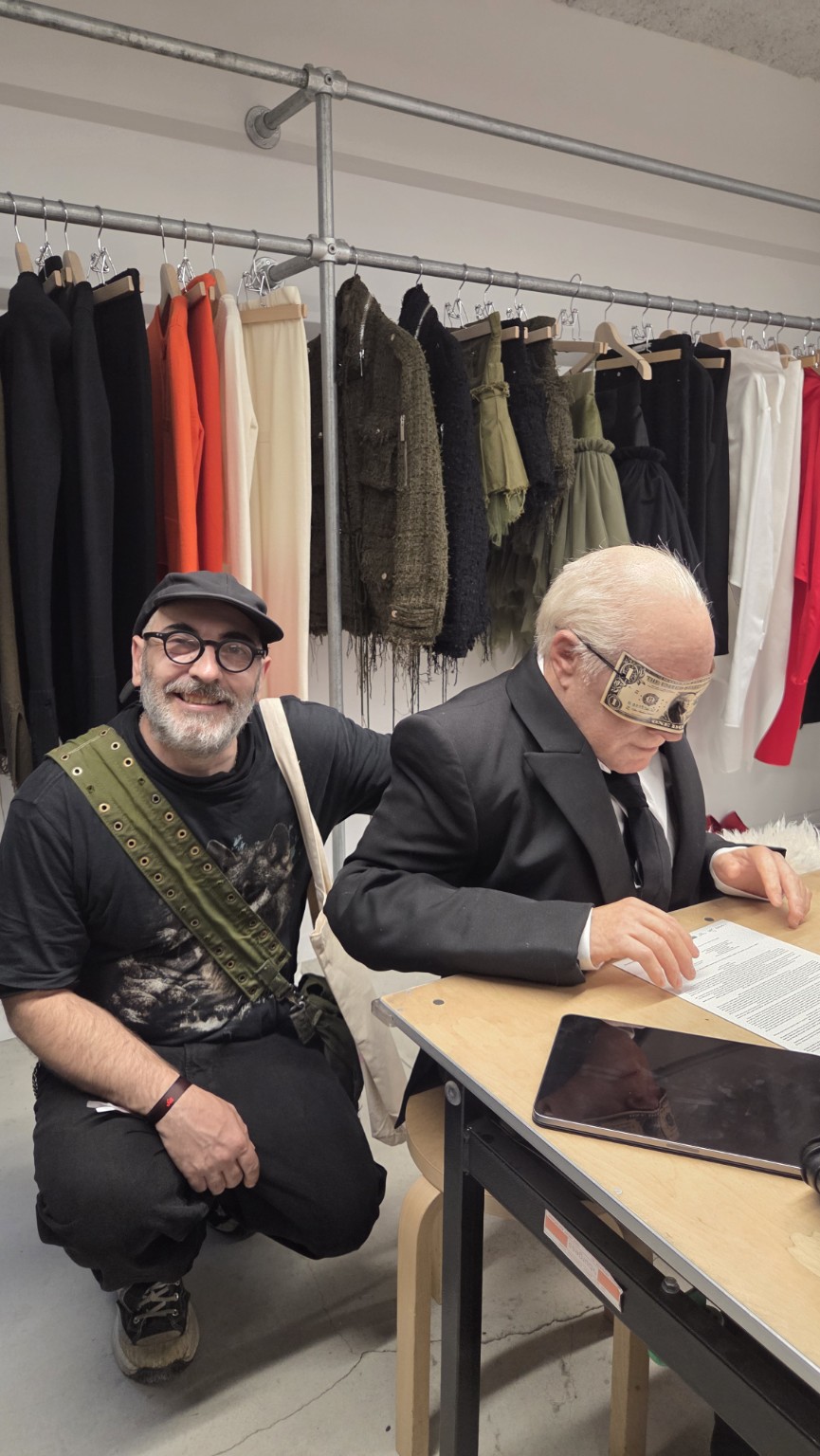
I first met Hannah Rose Dalton and Steven Raj Bhaskaran when they were my students at LaSalle College in Montréal.
We became much closer after they graduated. We've worked together on projects over the years, kept in touch, and somehow maintained our tradition of having dinner in Chinatown whenever we get the chance.
Their latest show, The Ninety-Nine Percent, practically broke the internet. Its imagery of social unrest seemed almost prophetic against the backdrop of protests in Paris. Jessy Collucci was there and told me he cried. Not because Rihanna was an hour and a half late.
I missed it.
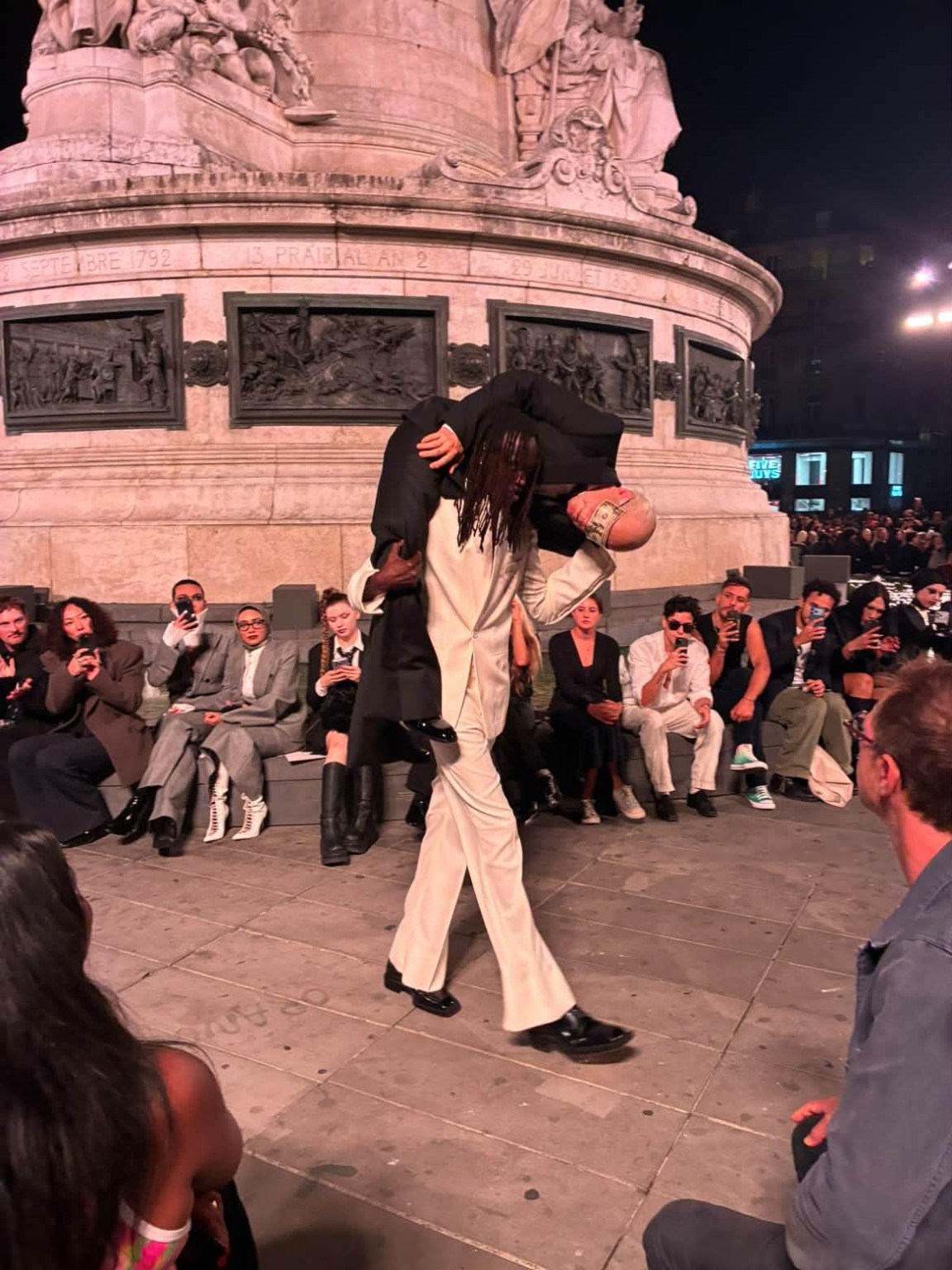
Photograph by Jessy Collucci.
I had to stay in Montréal to produce ON SHOW during Fashion Week. Not a particularly glamorous excuse, but someone had to make sure our own shows happened.
A week later, I had the opportunity to spend a few days in Paris for a talk at JILL. Hannah kindly arranged for me to stop by their showroom.
It was a chance to see them, however briefly, in the middle of everything that was happening.
Steven and I exchanged a few words about how crazy things had become. A model associated with Rick Owens walked in. A rather loud American rapper was talking beside us. People kept arriving.
I wanted to ask what was next, but it wasn't exactly the moment for a serious discussion about their five-year business plan.
We did manage to joke about one possibility: Matières Fécales stores around the world, selling at H&M prices. Complete democratization.
I rather liked the idea.
A few weeks later, I came across one of those Instagram posts inviting people to vote on the next creative director of Alexander McQueen. Seán McGirr had just left, and the internet was conducting its usual recruitment exercise.
Hannah and Steven were among the proposed candidates.
I thought they could be very good at it. I've imagined them at Givenchy, too.
Then I found myself wondering why I was so quick to imagine them working for someone else.
There is something peculiar about the way fashion recognizes independent success.
A designer spends years developing a point of view, finding collaborators, convincing people to take risks, getting collections produced, finding buyers and establishing a name.
Eventually the industry notices.
At which point the conversation often becomes about which established house they should direct.
We seem to have developed a system in which building your own company can function as an unusually expensive audition for running somebody else's.
The contradiction is easy to miss because the appointment is usually presented as a promotion. And for the designer, it may well be one. A substantial salary, an established atelier, access to exceptional manufacturing, a worldwide distribution network and a budget that doesn't depend on persuading three stockists to pay their outstanding invoices.
I understand the attraction.
I also understand the difference between a designer becoming successful and the business they founded becoming successful.
Those two things can separate quite dramatically.
What makes Hannah and Steven's situation particularly interesting is that their recent collections have been organized around precisely the questions of wealth and access that shape the fashion industry.
The One Percent examined the concentration of wealth and power. Its successor, The Ninety-Nine Percent, shifted attention toward those excluded from that concentration.
I won't attempt to review the collections. Plenty of people have already done that, and I'm more interested in the circumstances in which they were produced.
The luxury industry is itself an extraordinary example of economic concentration. A relatively small number of corporate groups control many of its most recognizable houses, with access to capital, distribution, production and marketing resources that independent designers can rarely approach.
I don't know what proportion of the market genuinely independent designer labels occupy. It depends on how independence and the market are defined.
But their position within the luxury economy is certainly much smaller than their cultural visibility might suggest.
That makes the relationship between The One Percent and The Ninety-Nine Percent interesting beyond the collections' intended social commentary.
An independent designer can criticize the concentration of power while trying to build a business inside an industry organized around that same concentration.
And perhaps that's exactly what they should be doing.
I've always told Hannah that the objective should be to offer an alternative to the fashion system, not simply to oppose it.
Opposition can become a position in itself. It can generate attention, a recognizable identity and an audience that appreciates the refusal to participate.
But if the ambition is to build something substantial, eventually you need to participate in some of the structures you're criticizing.
You need distribution. You need customers. You need capital.
Otherwise, you're still selling on Depop.
There's nothing wrong with Depop. It's simply not the same proposition as building an international fashion company.
Hannah and Steven's relationship with Dover Street Market is an important part of this story.
They're part of its Paris brand-development programme, associated with Adrian Joffe and the Comme des Garçons universe.
The programme provides young designers with mentorship and financial support, alongside access to a commercial and cultural network that would be difficult to develop independently.
I don't know the precise financial arrangements between Matières Fécales and Dover Street Market. Whether the support involves particular commercial obligations, ownership arrangements or other conditions isn't something I can responsibly speculate about.
But the visible results have been significant.
It's difficult to imagine their recent development without acknowledging the importance of that relationship.
And this complicates any simplistic argument about independence.
Dover Street Market is not an outsider to the luxury system. It is an influential participant in it, with an unusual capacity to recognize experimental work and help translate it into a business.
What Hannah and Steven have done is not to remain untouched by the industry. They've developed a relationship with an institution that can help them operate within it.
That seems to me a much more productive form of independence than refusing every available structure.
The important question is what the relationship allows them to build and how much control they retain over its future.
Independence doesn't have to mean doing everything alone.
In fact, that might be one of the least sustainable definitions of it.
Jonathan Anderson took over Dior's womenswear, menswear and haute couture in 2025. His namesake company, JW Anderson, subsequently moved away from the conventional runway model toward a more curated business involving clothing, furniture, objects and direct retail.
Its CEO, Jenny Galimberti, has described the transformation positively. There are perfectly reasonable commercial arguments for it. Wholesale is expensive, seasonal collections require constant investment, and direct distribution can offer better control of margins and inventory.
The new model may prove considerably more profitable.
But Anderson is now responsible for ten Dior collections a year.
The question isn't whether he remains talented enough to do both jobs. It's what the reorganization tells us about the allocation of his time.
JW Anderson had already accepted minority investment from LVMH, so this isn't a simple case of a conglomerate extracting talent from a completely independent competitor.
Still, one company receives the designer's principal professional attention. The company carrying his name develops a different operating structure.
Then there's Raf Simons.
He closed his namesake label in 2022 after twenty-seven years, while continuing to work alongside Miuccia Prada.
Simons later explained that he wanted more time for his personal life and felt he had told the story he wanted to tell through the label.
That explanation deserves to be taken seriously. A designer is allowed to finish something.
What interests me is that even Raf Simons, with his influence and experience, eventually chose not to maintain both activities.
Prada retained Raf Simons the designer. The industry lost Raf Simons the independent label.
Not necessarily because anybody engineered that outcome. But the outcome is worth examining.
I spend much of my working life trying to make independent fashion businesses viable.
At LIGNES DE FUITE, that means shared equipment, production capacity, mentoring, technical development and helping designers navigate the rather unromantic distance between an idea and something a customer can actually purchase.
The distance is considerable.
A young label can receive extraordinary press and still be unable to finance its next production run.
A retailer might place an order, but the manufacturer needs a deposit before starting. Materials have to be purchased, patterns corrected, sizes graded, garments cut and assembled. The balance of the order may not arrive until delivery, sometimes later.
Success can create a cash-flow problem faster than failure.
There is also the cost of maintaining the visibility that produced the orders in the first place. Each new season comes with expectations. The next show should be stronger, the casting more interesting, the imagery more ambitious.
The people who helped on the previous collection may now need to be paid properly, which is generally considered an excellent idea until somebody looks at the budget.
I've watched designers become culturally visible long before their businesses became economically secure.
That gap may be one of the most important things happening in independent fashion.
Instagram, independent magazines, stylists, celebrity dressing and the fashion-week circuit can turn a small label into an internationally recognized name without providing anything resembling an internationally sustainable business.
The audience sees a breakthrough.
The founder sees another season to finance.
A luxury group sees a potential creative director.
All three are looking at the same designer.
This is where my original suspicion about conglomerates becomes more complicated.
I initially wondered whether hiring the founders of promising independent labels might be an exceptionally efficient way for luxury groups to neutralize future competition.
Why acquire the business when you can recruit the people who make it valuable?
There is a resemblance to the logic of acqui-hiring in technology, where companies are sometimes purchased primarily for their teams.
But fashion's version isn't necessarily an acquisition at all. The label may remain legally independent. The designer may retain ownership. There may be no intention to weaken anybody.
The effect can nevertheless be significant.
A founder's time moves into an established organization. The independent business must adapt, hire management, reduce activity or eventually stop.
Sometimes that transition works. Sometimes it doesn't.
Perhaps the more interesting form of concentration isn't ownership of companies but the concentration of creative labour inside companies that already possess the capital, production infrastructure and distribution.
There is an important objection, however.
Perhaps the conglomerates aren't preventing independent competitors from emerging. Perhaps independent fashion is already structured in a way that makes becoming a serious competitor extraordinarily difficult.
A designer can achieve enormous cultural influence while operating a relatively small business. The same influence, placed inside an established luxury house, can be monetized through a global retail network, accessories, fragrances and categories that the independent designer may never have the capital to develop.
The conglomerate isn't necessarily buying a competitor. It may be buying access to something the independent company cannot yet fully commercialize.
Which makes the recruitment offer difficult to refuse.
There's an uncomfortable implication here for people like me.
We encourage designers to establish their own identities. We teach them to build businesses, understand production, develop collections, find customers and take responsibility for their work.
I believe in that process. I've invested years in building infrastructure around it.
But what if part of the independent fashion ecosystem is effectively financing the research and development of the luxury industry?
Designers pay for it through years of uncertain income. Families help. Small workshops extend credit or absorb the consequences of last-minute changes. Schools, mentors, independent retailers and sometimes public institutions contribute resources.
The label develops a reputation. Its founder becomes culturally valuable.
Then a major house can offer the founder a salary and the kind of infrastructure that the independent ecosystem has spent years trying to assemble in fragments.
The luxury group doesn't necessarily need the small company's inventory, liabilities or production problems.
It needs the person who learned to make something interesting despite them.
This isn't evidence of a coordinated strategy. It is a possible distribution of costs and benefits, and one that deserves closer examination.
It also raises a question about what organizations like mine are actually preparing designers for.
Are we helping build a new generation of independent fashion companies? Or are we, at least partly, operating a very elaborate talent-development programme for an industry that can afford to recruit the graduates?
There are less expensive ways to run a recruitment agency.
Of course, independence itself deserves some scrutiny.
Owning a company doesn't automatically make someone free.
A designer can retain complete legal ownership while having very little control over their time. The next collection is dictated by the showroom calendar. The product range is shaped by buyers. Production decisions depend on available cash. Creative ambitions are negotiated against minimum order quantities.
Meanwhile, a creative director employed by a large house might have greater practical freedom: specialist teams, research budgets, access to archives and craftspeople, and the possibility of developing ideas that would be financially impossible independently.
Ownership and autonomy are not the same thing.
Nor should every designer be expected to become an entrepreneur. Some people want to design. They don't necessarily want to manage payroll, negotiate leases or spend Sunday evening calculating margins.
A successful creative-director appointment may allow them to do precisely what they're best at.
I don't think anyone should be asked to sacrifice a secure and fulfilling career to preserve somebody else's romantic idea of independence.
Including mine.
But I do think we should distinguish between a system that offers designers a genuine choice and one in which the economics make one choice increasingly difficult to sustain.
This is why the Dover Street Market relationship matters.
It suggests another possibility between isolated independence and complete absorption into a conglomerate: a designer-led company supported by an established institution.
The arrangement may come with its own compromises. Every commercial relationship does.
But perhaps the objective shouldn't be to escape the system entirely. Perhaps it should be to develop enough economic power to negotiate with it.
McQueen makes this especially interesting.
Lee Alexander McQueen established his own label in 1992, became creative director of Givenchy in 1996 and saw Gucci Group acquire a controlling stake in his company in 2001.
His career combined independent authorship, employment at a major house and corporate investment.
Today, the company he founded belongs to Kering and is searching for new creative leadership.
The founder's name remains. The ownership, management and creative direction have changed.
The house has become an institution capable of continuing without its founder.
And now the internet is proposing that Hannah and Steven, who have spent years establishing Matières Fécales, should become the next people responsible for maintaining that institution.
I can see why.
But I'm also interested in the possibility that Matières Fécales might become an institution of its own.
Not necessarily another McQueen, and certainly not another Kering.
It could mean a company with enough commercial stability to employ people over decades, develop technical expertise, retain its intellectual property and continue producing work without depending entirely on its founders' physical presence.
That is a different kind of achievement from becoming a celebrated creative director.
It is also considerably harder to photograph.
Which brings me back to that rather absurd conversation in the showroom.
Matières Fécales stores around the world. H&M prices.
It was a joke, but there's an interesting proposition hiding inside it.
What if the most radical thing an independent designer could do wasn't to produce an image that criticizes the luxury industry, but to build an alternative capable of operating at scale?
Not simply to expose the concentration of wealth, but to change who has access to design, production and distribution.
Of course, selling Matières Fécales at H&M prices would introduce a few practical complications.
Someone would have to finance the inventory. Manufacturing costs would need to fall dramatically. Distribution would have to expand. The company would need management, logistics, retail infrastructure and enough volume to make the prices possible.
And the question of how garments could be produced responsibly at that price would be difficult to avoid.
The revolution would require an exceptionally competent operations department.
Still, I find the possibility more interesting than another appointment announcement.
There's an enormous difference between criticizing an economic system and developing a viable alternative to it.
The first can happen through a collection.
The second requires a company.
I don't know what Hannah and Steven want next, and I wouldn't presume to tell them.
Their relationship with Dover Street Market may already be helping them build something far more durable than their current visibility suggests. I don't know enough about the financial arrangements to judge that.
Nor do I know whether either of them has any interest in McQueen or Givenchy. An Instagram poll is not a job offer.
But I keep thinking about the distance between their two recent collection titles.
The One Percent.
The Ninety-Nine Percent.
And an industry in which a remarkably small number of organizations possess the resources to turn creative influence into global commercial power.
I've spent years encouraging designers to build something that belongs to them. Yet when I see two people I've known since their early days achieving international recognition, I catch myself imagining which established house might employ them.
It makes me wonder how thoroughly the industry's hierarchy has entered my own thinking.
Perhaps Hannah and Steven will one day direct McQueen. Perhaps that would be exactly the right decision for them.
Or perhaps they'll build Matières Fécales into a company capable of operating on its own terms, supported by institutions when useful, without surrendering the possibility of becoming one itself.
I don't know.
But I rather like the idea of walking into a Matières Fécales store in some unexpected city twenty years from now.
Especially if I can afford something.
OPINION
Recevez les nouveaux articles LDF et les projets liés à ce sujet.
CHOISIR CE SIGNAL ↓
AUDREY BÉDARD
EN · EnglishOUVRIR L’ARTICLE → Design Process Interview
Koura Rosy Interviews Fashion Designer Wan Hua Li: Exploring Identity Through Design
EN · EnglishKoura Rosy · 6 MIN →Reading into Atelier Details
EN · EnglishLDF Editorial · 6 MIN → Words of advice
From Anna-Maria Varriano to Giovanni Caci
EN · EnglishGiovanni Caci · 24 MIN → Design Process Interview
Resonance of Solitude: Giovanni Caci's Ostracism-Inspired Collection
EN · EnglishDanielle Medland · 6 MIN →Breaking Down Gender Norms: A Journey into William Crosson's Graduate Collection
EN · EnglishWilliam Zhang · 7 MIN → Words of advice
From Daniel Henry to William Crosson
EN · EnglishWilliam Crosson · 7 MIN → Fiction
Break up Lettre
EN · EnglishDanielle Medland · 9 MIN →FAIRE GLISSER POUR EXPLORER →